Tag: Leadership (page 9 of 13)

6 Reasons a “Yes” Man will Demolish Your Vision

Creation Swap User Savannah Daniel

Having a team of people around you that agree with you on everything feels great in the moment. You feel like a king issuing awesomeness at every turn. Every idea, every decision, every complaint and every shout is greeted by a resounding, “Yes!” You can’t do anything wrong. Everybody wants to be you.

Little do you know, you may be leading your organization straight into the ground.

While I was in grad school, I called these guys, “lackeys.” Familiar with the term? A lackey is, formally, someone who does menial tasks or runs errands for another.” (Merriam-Webster) I define it as someone who is constantly at your beckon call. In grad school, these were the guys who wore suits to class every day and ran little errands around for the professor. It was pitiful, really. Everywhere the professor went, so did the lackey. These guys were little clones, thinking and teaching like their leader.

Every leader can find little “lackeys.” Every leader, however, should surround themselves with people who think and operate differently.

Because a “Yes” man just could demolish your vision.

6 Reasons a “Yes” man will Demolish your Vision

1. Maybe you need to hear, “No.”

For “no” – I can sometimes have some dumb ideas. Really dumb. And I need someone to say, “Nope. Move on. Start moving in a different direction.”

2. Maybe you need to hear, “Yes.”

I have a tendency to be pretty hard on myself. Yet sometimes my ideas are really good. And I need someone to come alongside me and encourage me with, “Yes, your’e headed in the right direction even though you may think you’re not.”

3. You need pushback on your ideas

I process things out loud, so I need someone who’s going to push back on my ideas and not just take them at face value because I said them. I need the occasional, “Why? Are you sure? Why now? Why him? Why not this?” Reminder to self: you’re not as great as you think.

4. Unity is not the same as conformity.

We should pursue unity, but that doesn’t have to be conformity. Unity means that we can operate together as a team even though we have differing ideas. Unity promotes healthy growth. Conformity can produce growth, but it can also lead to a cess pool of thoughts that never evolve and get better.

5. Commiserating can take you down a dangerous path.

Ever headed there? It starts out innocently. You’re tired and frustrated, so you vent to someone else. And instead of them saying, “Whoa…hang on. You’re pretty bitter and angry right now. Why don’t you take a breather and come back in a few minutes?” They say, “Whoa…you’re right. That’s awful. In fact, it’s worse than you thought. Let me tell you about ___.” If you’ve ever been there, you know that this is a slippery slope.  “He who walks with the wise grows wise, but a companion of fools suffers harm.” – Proverbs 13:20

6. “Leaders” are vital.

Leaders think for themselves and help the organization pursue what’s best for it. They don’t exist just to follow your leadership. They’re using the gifts God’s given them, and when they do that it is a thing of beauty for them and for you. Leaders produce leaders…followers do not. “Yes” men aren’t necessarily leaders. If you’ve only got followers in your organization right now, don’t expect them to produce, and attract, leaders.

Question:

Do you have people in your life that frustrate you because they always push back on your ideas?

*photo credit: Creation Swap user: Savannah Daniel


The con panna

When I was in graduate school, I worked at a coffee shop.

There, I developed a great love for coffee.  Good coffee.  Coffee that’s handpicked, handcrafted, and consumed at just the right temperature.  Coffee that’s paired with the right pastry, in the right season, at the right…heck, who am I kidding?  I’ll drink coffee anytime.

My all-time favorite hand-crafted masterpiece was the con panna.

photo via Justin Mcintosh

Con Panna means “with cream,” and it’s a simple drink to make.  Grab a canister of whip cream.  Then pull 2 (or, if you’re feeling extra frisky, make it 3) shots of espresso.  As soon as the shots are done brewing, transfer the shots to your demitasse cup, then top with whip cream.  It’s heaven. In a cup.

Most coffee shops, though, won’t have this drink listed on the menu.  They’ll have the traditional cappuccinos, lattes, and cafe mochas.  But no con panna.  And it’s not that they don’t know how to make it.  It’s just not a huge seller in America.  Most people in America want something with a little less kick…a little smoother and creamier.  They’re not looking for something with so much punch.

But if you want to be super cool, just order a con panna next time you’re at your local coffee shop. The barista will look at you with eyes that say, (*read the following with an Italian gangster accent)

How do you know about the con panna?

Then you’ll look back with eyes that say,

Hey! I know my stuff!

To which his eyes will respond,

A’right. A’right. I didn’t know. I’ll give ya a little respect.

To which your eyes will respond,

Don’t mess it up. I might mess you up.

I’ve shared the beauty of this drink with a lot of folks who frequent coffee shops.  You know what every one of them tells me?  “I am going to order that drink next time I go!”  Why?

Because everyone wants to feel like an insider.

There’s something about us that wants to feel like we have a leg-up on others.  That we’re a step ahead.  We know a bit more.  We are in a bit deeper.  We’re just a little bit more awesome than the rest of the people in this coffee shop.

You might spin that thought and think that it’s related to pride.  But I don’t think it is.  I think it’s a reflection of our desire to learn, grow, change, and improve.  And when it comes to leading people, this is an invaluable quality to overlook.

In leading people, help them feel like they’re insiders.

  • Let them know what’s coming next…before it comes.
  • Run an idea by them before it’s announced publicly.
  • Ask for their input in prep for your next event.
  • Tell them an idea you’ve been sitting on but haven’t fleshed out.
  • Ask them to lead in an area that you haven’t yet explored as an organization.
  • Encourage them to bring their ideas to the table…and then act on some of them.

The more knowledge you give people, the more valued they feel.

The more knowledge you give people, the more they feel like a vital part of the organization.

The more knowledge you give people, the more they will give of themselves.

The more knowledge you give people, the better results your entire team will experience.

Try it.

Question:

Have you ever had a con panna?  Do you even like coffee?


5 Leadership Lessons Curious George Teaches us

My son loves when we read Curious George to him.  It’s one of his favorites!  But I read everything with a critical eye.  And while I don’t always appreciate that part of me, I just can’t turn that switch off and just completely read for fun.  I wish I could.

Image via MyDorchester

Yesterday, I told you about the bad parenting lessons I’ve learned from Curious George. (you can read that HERE)

But I’d be remiss to say there aren’t some great jewels of life wisdom here, too!  Even wisdom that leaders can glean.  To be honest with you, I never thought I’d be learning leadership lessons from a cartoon monkey.  But, alas…the life of a dad…

5 Leadership Lessons Curious George Teaches us

Enjoying life is infectious.

When you enjoy life, you help others to do the same.  At the end of every book, the entire cast of characters is smiling.  Not to say that life’s easy or fluffy or always happy, but looking for ways to enjoy the gifts and opportunities God’s giving you is infectious for everyone around you.

Helping people is messy work.

George’s goal throughout the series is to help people.  But in helping people, he often gets into big messes.  Before it’s all said and done, many people are frustrated with George.  Even those who love him the most (the man with the yellow hat).  Which is what you’ll sometimes, unfortunately, find in life.  Helping people change, grow, and deal with life is often messy and frustrating.  But I can’t even begin to tell you how it’s worth the frustrations.

Creativity is messy and chaotic, but at the end of the day, it’s worth it.

If you pursue creativity in life, things will get messy and chaotic.  Rarely will you find yourself in the middle of creativity and in the middle of order.  Just know, going in, that you’re going to have to put up with a bit of chaos in the creative process.  But at the end of the day, it’s worth it.  The insights, new directions, and “art” you’ll create through the process make it worth the effort.

Curiosity will get you in lots of trouble.

The more you poke around, question systems, and look for new ways of doing things, the more you will frustrate some people.  Because, often, it’s easier to leave the status quo untouched.  To assume you can “arrive” and be done growing and changing.  And the more you push for those out-of-the-box changes, the more you’ll frustrate those who are satisfied with keeping things the way they are.

Curiosity will lead you to lots of fun.

Children naturally gravitate towards creativity and fun.  But life has a tendency of breaking many of us of that.  Curiosity is a beautiful thing.  It leads to new discoveries and new adventures, as long as you’re willing to pursue it.  Don’t get so tangled up in details, systems, and processes that you forget to have a little fun along the way.  There’s an adventure around every corner if you’re willing to look.

Question:

Have you seen any of these lessons come true in your life?


No more excuses

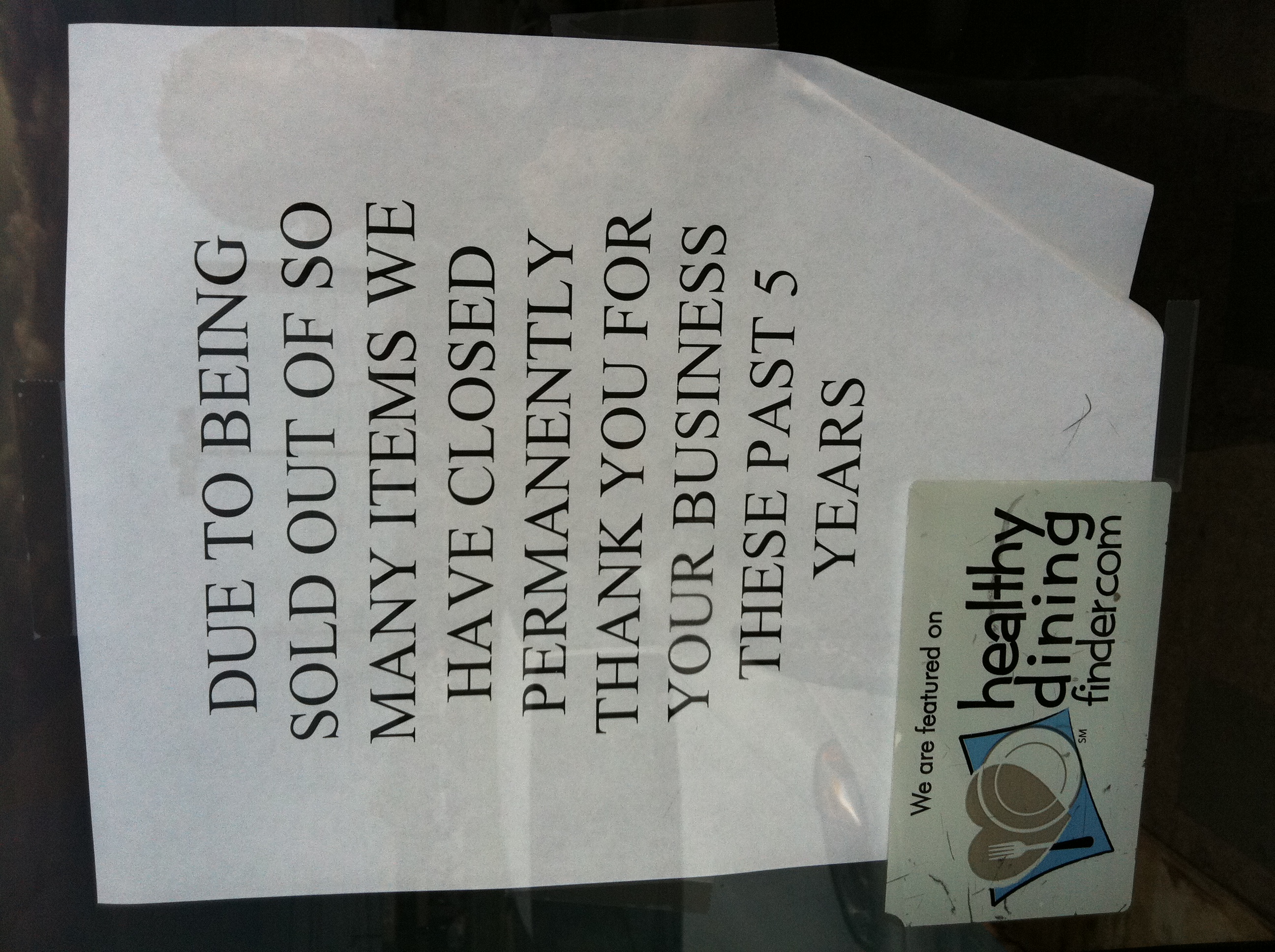
I saw this sign at a local food chain yesterday:

Last time I checked, being “sold out” meant you were selling things…which was good for business.  Right?

And if business is going so well that you’re selling out of supplies, shouldn’t you be looking for more suppliers?

I’m convinced that many people are just hunting for excuses to not do what they need to do.  Even when all of the signs are pointing in the same direction.  It’s easier to find excuses than it is to do the hard work required to be successful.

There’s rarely anything magical about success.

It’s more often about hard work, even when nobody else is looking, than it is about you being in the right place at the right time. (before you comment, know that I’m not taking God out of this equation at all.  He’s sovereign, and chooses what He wants to do…but I don’t think that God rewards laziness.)

Don’t let a lack of supplies become your excuse.

Don’t let a lack of volunteers become your excuse.

Don’t let a shortage of financial resources become your excuse.

Don’t let a hater’s discouragement become your excuse.

Don’t let, “We’ve never done it like that before” become your excuse.

Do the hard work, even when it’s not fun.

In the end, it’s worth it.


Don’t be anonymous

The more and more I’m active in social media, the more and more anonymous commenters I seem to attract.

Image via Guardian


And at one level, I get it. Anonymous comments are a chance to share what you really think, without the ramifications of having to deal relationally by asking hard questions, making pointed statements, and pushing someone in a way you wouldn’t normally do in person. I get it. But if you’re going to make some strong statements, don’t hide behind a false name. Be real.  Give the person you’re attacking the chance to talk to a real person…not just a fake name.

Here’s the principle behind what I’m saying:

If you believe in what you’re saying, sign your name to it.

This principle holds true with many things in life.

If you’ve got a good idea, and you believe in it, sign your name to it. If you don’t believe in it, why promote it?

If you’ve got a new policy, and you believe it’s worth implementing, sign your name to it. Stand behind it. If you’re not willing to stand behind it, and deal with the questions and complaints, why implement it?

If you’re ready to hire a new person, and you believe they’re the right person for the job, stand behind them. Let everyone know you believe in this person. If you don’t believe in them, don’t hire them.

If you’re leading your organization in a new direction, stand behind the decision. There may be bumps along the way, but if you believe this is the direction you should go, then show everyone you believe in it.

Anonymous people rarely get anything done.  It’s when you are willing to sign your name to what you believe that the ball can begin moving forward.

We don’t need more anonymity.  We need leaders.

Question: Have you ever gotten anonymous comments on something you’ve done?


5 Foolproof ways to avoid the “When is this over?” glance

How, during a meeting, do you check what time it is without the other person thinking you’re bored?

image via Fotolia

That’s got to be the most awkward glance ever.  Even more awkward than the, ‘Was that you?‘ glance you get in an elevator.

If you glance down during a meeting, it’s as if you’re saying, “Why are you so boring?  Why am I here?  Why are you here?  I can’t even stand to listen to you.”

You can try to cover it up with the classic, “I have another meeting…” OR, “Wow!  The time has flown!’

But there’s no real recovery. Especially when you’re only 10 minutes in to an hour-long meeting.  The damage is done.  Irreparable.  Any good you hoped would come out of that meeting left with the glance.

The Damaging Downward Glance

The glance at your watch is damaging because you’ve devalued the person. And nobody wants to be devalued or criticized or condemned.  Everybody wants to feel important, that they bring some value to the table beyond filling the space before your next meeting.

But the reality is that you may another commitment.  And your current cup of coffee can’t go on forever.  So how do you avoid the awkwardness?

5 Ways to avoid the “When Is This Over?” Glance

1. Check the other person’s watch.

I’ve done this.  It works.  Because you never have to move your head…just your eyes.

2. Always wear dark-colored sunglasses.

Then nobody knows where you’re looking.

3. Drop your pen and sneak a peak.

4. Drop the line, “My phone is blowing up today!” …and sneak a peak.

5. Have predetermined starting and stopping points.

Then everyone is clear right off the bay what the expectations are. Let them know that you have another meeting to attend as soon as yours is over.  Acknowledge the awkwardness before it hits.  Honesty is the best policy. ‘I hate to be that guy, but…I’ve got a meeting right after this.”  Or you could say, “I don’t want to cut things short, but I’ve got to be done here by _:00.”


Good leaders are good listeners

My son is piecing lots of words and thoughts and phrases together.  It’s quite hilarious, actually.  Here are a few he’s said recently.

Right there!  Daddy…Poppy…eat…hot!

Translation: “I ate dinner there with Poppy one night, and his plate was so hot it burned me.”

Oh no! Wait…Daddy…church…right there!

Translation: “We just drove by the road that we turn down to go to church…turn around!”

Me…Daddy…play…school

Translation: “Daddy and I played on the playground at that school and it was fun!”

Daddy…outside…work…help…me

Translation: ‘I helped Daddy work outside.’ (see picture below for when he said that)

Daddy…back…hat?

Translation: “Daddy, would you turn your hat around backwards?”

Daddy…yucky

Translation: “Daddy, you smell bad.”  (I get that one a lot…)

But this is the one that takes the cake:

Daddy die!

Out of context, this statement from my son seems oddly dark and twisted.  In context it makes perfect sense.  I promise you my son is not a weirdo.

See, if you’d been there in the moment, you wouldn’t have thought anything was out of place.  He was riding his four-wheeler, and right in the middle of the yard, the battery died.  All he was doing was letting me know that, so that I’d go plug it back in and charge it up.  Not weird at all.

And that’s what building a relationship does.  It helps put things into context.  It helps make sense of a person.  Learning their story, understanding their struggles, their heartaches, their missed opportunities, their hopes and dreams takes them from being an “outsider” to being someone you relate with and that you can serve with.  All of a sudden, they’re not so un-relatable…you begin to see how your stories at some level mesh, and how you can speak truth into that person’s life.

Relationships are difficult, no doubt.  And they’re messy and frustrating and will test your patience and your life’s calling.  But taking the time to hear someone’s story, helping them pull out the bright spots, shining light in the dark places, will make you a better leader.  Because through truly getting to know people, not just brushing them off and casting them to the side, you’ll grow to love them more.

People aren’t a means to an end.  They’re your calling.  It doesn’t matter what “business” you’re in.

Good leaders are good listeners.


The most powerful way to encourage attendance

I recently got an invitation to attend a lunch with other like-minded leaders in Nashville. I was invited by the organizer of the event, because apparently “this is an event you’ll like.”

And I said, “I’ll be there.”

Was the exact same DM (that’s twitter shorthand for a message sent directly to you) sent to (probably) hundreds of other guys?  Yep.

Was it really just a way of getting a bunch of leaders in the same room to promote what they wanted to talk about?  Yeah. (I know, I know…you told us it wasn’t…but be honest)

If I’d gotten the exact same DM from the sponsoring company, would I have gone? Not a chance. *(this is an important marketing tip for churches and businesses.  If I receive an invitation from your corporate account, 99 times out of 100 I’ll ignore it.  Send it from  your personal account and it’ll get at least a second look)

But do you know why I went?

Because I got a personal invite from a real person.

I felt needed. I felt valued.  I felt that this event would be worth my time and effort to attend.

If the parent company had sent the DM, it would’ve felt pushy.  But coming from the person, it felt…personal.

The takeaway

Instead of sending out fliers for your next church event, encourage people to personally ask their friends.

Instead of buying a spot on a billboard to promote your event, encourage word-of-mouth.

Instead of blasting a mass email, encourage people to invite a few of their closest friends on Facebook.

“Personal” is a stronger, more meaningful “ask” than the mass appeal.

Question: Would you be more likely to attend an event if personally invited by someone you trust?


Leadership challenges

Leadership is challenging.  Whether you’re a leader in your community, your job, or your church, you’ve run into the difficulties that each and every leader faces.  Maybe your challenges are unique…but my guess is that they’re not.

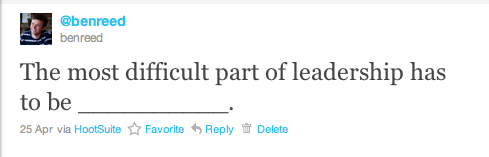
I posted this on Twitter and Facebook recently, to see what other challenges leaders face:

I got some great (and some goofy) comments, so I thought I’d share them with you.

The most difficult part of leadership has to be…

I would add the following

  • change
  • recruiting volunteers
  • keeping the mission and vision front and center
  • creating momentum
  • managing AND leading
  • admitting when you’re wrong

What did I miss?

Do you enjoy leading, or is it more of a burden to you?


The anticipation

I love being a dad.

It’s not easy, by any stretch of the imagination.  But it’s good.

And one thing that we as a family love is laughing together.  And one way I personally promote that is by tickling my son.  It makes both of us laugh hysterically.

I don’t know if you’ve ever tickled a 2-year old, but it’s pretty funny.  It’s hard not to laugh along with them.

And I noticed this the other day: my son starts laughing before I even tickle him.

I just curl up my hand, like I’m going to tickle him…and just get it close to his belly, and he starts to cringe up in laughter.  And it’s not one of those courtesy chuckles.  It’s an all-body laughter.

The anticipation plays into his overall tickle experience.


And I’m convinced that Sunday mornings are similar.

From week to week, we should be building anticipation as to what’s coming next time.  Whether that’s through

  • sermon series
  • serving opportunities
  • small group/Sunday alignment
  • emails saying, “Get ready…”
  • social media connections
  • website resources
  • mixing things up on Sundays so people really don’t know exactly what to expect
  • building relationships that encourage continued gathering with other believers

We should be thinking, “What’s encouraging our folks to come back next week?”* Is there a reason for a newcomer (who may or may not be a follower of Christ) to return?  How are you communicating to them that coming back next week is vital?  Are you following up throughout the week?

If you believe that the message you’re presenting is valuable, why would you not create tension and anticipation for what’s coming next?

TV shows do it.  Movies do it.  Radio talk shows create it.  Teachers create it.  Guys who want a second date build it.

If you want a second round with a visitor, you’ve got to build anticipation.

How are you building anticipation?

Should we build anticipation, or should the message simply speak for itself, standing alone?

*Before you leave theologically charged comments, let it be known…I believe that God is the one who draws and changes hearts.  He is the Motivator.  It’s his kindness that leads us to repentance.  I just don’t want anything to get in the way of that, if I can help it.


Older posts Newer posts

© 2026

Theme by Anders NorenUp ↑