Tag: Church (page 6 of 8)

The End of Global Poverty

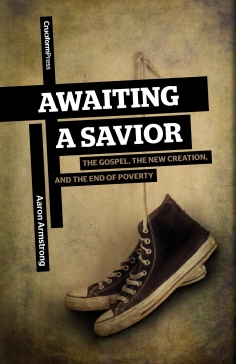
A friend of mine, Aaron Armstrong (Twitter, Facebook, and blog) has just released a new book entitled Awaiting a Savior: The Gospel, the New Creation, and the End of Poverty

This post is completely unsolicited…I think it’s such a helpful resource that I wanted to sit down with Aaron and have him answer a few questions so that you’d be encouraged to pick up a copy. In fact, they’re really cheap right now…$8.45 for a hard copy, and just $5.45 for a digital copy!

Instead of having you read the interview, I decided to record it. *sorry that I cut the top portion of my video off…I’m still learning.


Aaron Armstrong Interview from Ben Reed on Vimeo.


A Key To Leading Volunteers

Make volunteers feel special!

image via Creation Swap

When I was a senior in high school, I was a part of the organization called National Honor Society. And though it felt at times that we existed as an organization purely to meet in between 4th and 5th periods, we did do some good.

One afternoon, we took a trip to an elementary school to help them promote their Fall Halloween Festival. We read books to the students, interacted them, and encouraged them to invite their families to the event that night. My main role was to hand out little trinkets to each student as they left the auditorium. I know…incredibly exciting and important. But I took it upon myself to make each and every student feel special.

So I’d act like each each student coming through was the only person on the planet who got that little spider ring. That spider ring was, according to all standards of financial reason, worthless. But according to that student, their little plastic spider ring was more valuable than a brand new diamond ring.

It’s all about perspective and value.

Which relates to all areas of leadership.

Value and Celebrate Volunteers

If you value those you lead, they’ll feel valuable.

Treat them like they’re a hired hand, and that’s exactly what they’ll feel like.

Treat them like without them you’d suffer. Let them know that their contribution matters.

Email them. Call them. Text them. Take them to lunch. Buy them a cup of coffee. Write them a letter. Have a dinner where you honor them. And give them a plastic spider ring while you’re at it.

Whatever you do, make them feel valued. Make them feel like they’re insiders.

Better yet…make them insiders.

*image via Creation Swap user: Amber Sprung


Oops…I just “churched”

photo credit: Clarksville Now

I know that the word “church” isn’t grammatically an action verb.

But neither is the word “Facebook,” and we use it like it is.

“I’ll Facebook you later today…”

“What’s your name? Great…I’ll Facebook you!”

Neither is the word “Google,” but we verb it up, too.

“I have no idea what the population of Idaho is, so I’ll Google it.”

So can you give me a little leeway? Because last Saturday, I “churched.” By that, I mean I WAS the Church. I didn’t attend a mass. Or give my tithes. Or sit in a pew. I didn’t hand out welcome bulletins or greet new visitors.

I was “the Church” in action verb form.

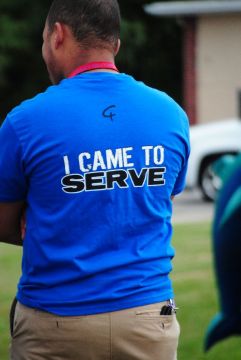
On Saturday, I was a part of a mobilizing of people from Grace Community Church who worked to make a difference here in our city. We called it Operation Serve, and this is the 6th year we’ve done this. We worked in partnership with the city of Clarksville to send out over 1200 volunteers.

Some of us remodeled houses.

Some landscaped.

Some played with special needs children.

Others worked on projects with non-profits.

Did we serve because it’s the cool thing to do? Nope.

Did we serve because that’s what we were told we had to do? Nope.

We served because that’s what the Church does. The Church serves because we follow the lead of our Savior who served us. Our Savior who is in the business of making old things new again, righting wrongs, and healing the broken.

We served expecting nothing in return. We didn’t have a string attached to our hammers that said, “We will help if you _____.” We don’t serve so that we can get something in return, but because that’s what we were created to do. That’s who we are and how we love.

We serve because we’ve been served. We love because we’ve been loved. We give because we’ve been given much.

This Sunday, millions will gather to worship. They’ll “go to church.” And while that’s an important part of being a follower of Christ, we want to remind the world that we, the Church, don’t simply exist to gather in our own little huddles. The Church is here to make a difference in our community. To leave things better than we found it.

Last Saturday, we put our faith on display.

But someone will say, “You have faith and I have works.” Show me your faith apart from your works, and I will show you my faith by my works. – James 2:18

*Photo credit: Clarksville Now


Structured Sunday Services & Crazy People

Creative commons: Kai Blake

I’ve heard people say that a structured, time-sensitive service isn’t one that leaves room for the Spirit to work.  Ever heard that?  Ever said that?

The conversation starts innocently like this:

I wish we could have sung another song…or chorus…or verse.

OR

I wish that _____ (my pastor) could’ve preached just a little longer. OR It’s over already?

And then you follow it up with this bomb

…because the Spirit needed just a little bit longer to work on ____. (or, sometimes if you’re feeling extra humble, you’ll say that the Holy Spirit needed a little longer to work on you.)

And for saying that, I call you a crazy person.  Because that’s the only category you fit in right now.

“Why, Ben?” you say.  I’ll tell you in 6 points.

6 Reasons to Structure your Sunday Services

1. It says it in the Bible.

Multiple times in the Bible, it tells us that all Sunday morning church services are supposed to last for 1 hour.  Don’t question me on that.  I went to seminary.

2. We pastors can’t work more than an hour straight.

Like “they” say, preaching a normal-length sermon is like working an 8-hour day. So if we have 2 services every Sunday, we work a 16 hour day.  And if we, like we do at Grace, have 3 live services on our campus on Sunday, it’s like we’ve worked a 24 hour day.  And you want us to do more?!?  You walk a hard line, my friend.

3. How “bad” are you that the Creator of the universe can’t do anything in your life in a solid hour?

*I’m pausing here for dramatic effect, then peering judgmentally over the top of my glasses at you as they slide down to the end of my nose.

4. When you have multiple services on a Sunday, logistics dictates that you have some structured order.

After all, the next service, full of people ready to experience God, is coming.

5. Structure isn’t bad. Is it?

Since when has structuring something been considered evil? We see nothing in the Scriptures saying that limiting the length of a service is anti-Holy Spirit. In fact, we at Grace have found that people are more apt to engage when they know that there will be a planned start and stop time.

6. Structure doesn’t have to limit the Spirit.

To think that the Holy Spirit is limited by time is thinking very little of the Spirit. Can God not work in an hour? How much longer does He need? Does He need just a few more minutes to really do His best work? One more repeat of the chorus…one more killer illustration…one more winsomely timed video?

*image via Kai Blake


The con panna

When I was in graduate school, I worked at a coffee shop.

There, I developed a great love for coffee.  Good coffee.  Coffee that’s handpicked, handcrafted, and consumed at just the right temperature.  Coffee that’s paired with the right pastry, in the right season, at the right…heck, who am I kidding?  I’ll drink coffee anytime.

My all-time favorite hand-crafted masterpiece was the con panna.

photo via Justin Mcintosh

Con Panna means “with cream,” and it’s a simple drink to make.  Grab a canister of whip cream.  Then pull 2 (or, if you’re feeling extra frisky, make it 3) shots of espresso.  As soon as the shots are done brewing, transfer the shots to your demitasse cup, then top with whip cream.  It’s heaven. In a cup.

Most coffee shops, though, won’t have this drink listed on the menu.  They’ll have the traditional cappuccinos, lattes, and cafe mochas.  But no con panna.  And it’s not that they don’t know how to make it.  It’s just not a huge seller in America.  Most people in America want something with a little less kick…a little smoother and creamier.  They’re not looking for something with so much punch.

But if you want to be super cool, just order a con panna next time you’re at your local coffee shop. The barista will look at you with eyes that say, (*read the following with an Italian gangster accent)

How do you know about the con panna?

Then you’ll look back with eyes that say,

Hey! I know my stuff!

To which his eyes will respond,

A’right. A’right. I didn’t know. I’ll give ya a little respect.

To which your eyes will respond,

Don’t mess it up. I might mess you up.

I’ve shared the beauty of this drink with a lot of folks who frequent coffee shops.  You know what every one of them tells me?  “I am going to order that drink next time I go!”  Why?

Because everyone wants to feel like an insider.

There’s something about us that wants to feel like we have a leg-up on others.  That we’re a step ahead.  We know a bit more.  We are in a bit deeper.  We’re just a little bit more awesome than the rest of the people in this coffee shop.

You might spin that thought and think that it’s related to pride.  But I don’t think it is.  I think it’s a reflection of our desire to learn, grow, change, and improve.  And when it comes to leading people, this is an invaluable quality to overlook.

In leading people, help them feel like they’re insiders.

  • Let them know what’s coming next…before it comes.
  • Run an idea by them before it’s announced publicly.
  • Ask for their input in prep for your next event.
  • Tell them an idea you’ve been sitting on but haven’t fleshed out.
  • Ask them to lead in an area that you haven’t yet explored as an organization.
  • Encourage them to bring their ideas to the table…and then act on some of them.

The more knowledge you give people, the more valued they feel.

The more knowledge you give people, the more they feel like a vital part of the organization.

The more knowledge you give people, the more they will give of themselves.

The more knowledge you give people, the better results your entire team will experience.

Try it.

Question:

Have you ever had a con panna?  Do you even like coffee?


Let’s speak Gibberish

My wife and I recently went to the beach, and saw a strange sight.

There were four ladies standing in a circle, obviously together and doing something.  We, not being nosey, passed on by.

It’s blurred…don’t judge me for taking a “curious” pic

But I couldn’t help overhearing them talking.  And I couldn’t help noticing that it was another language, one that I didn’t understand.  I didn’t think anything about it.  My wife and I moseyed on, looking for sea glass as the sun rose.  But then I heard a little English.

Oh, look who’s here!  It’s _____.  Yeaaaaaaaah! (*said very loudly)

So apparently _____ is a popular person.  Then I heard this little diddy drop:

You guys ready?  Let’s speak some gibberish!

So…I figured out what that “foreign” language was that the ladies were speaking.  Gibberish.  Nonsense.  Unintelligible words.  They would speak this gibberish, and, from a distance, appeared to be having a perfectly normal conversation.  Then they would force laughter (it wasn’t natural…just trust me on that) that was heard all the way across the beach.

And you know when you hear people laughing, and it makes you want to laugh, too?  Yeah, this wasn’t that kind of laughter.  It was just weird.

Confession: I don’t know what they were doing.  They may have been practicing for improv.  They may have been just purely being silly.  They may be a strange cult.  I don’t know.  But as an outsider, it was strange.  Borderline creepy.

And I think that this is how many people view our local churches.  And when we don’t keep them in mind when we structure our Sunday morning experiences, we keep them at the edge.  Here’s what I was thinking when I saw the women, and what I believe outsiders think of our local churches.

Local Churches & The Gibberish People

The closer I get the weirder they’ll be.

I heard enough to know that I didn’t want to get any closer to this group.  Offer new folks the chance to see your church at a snapshot.  Make it easy for them to try community out.  Easy to serve.  Easy to test the waters.  You know that if they experience community, they’ll want more.  So make it easier to get close.

They’re really speaking another language I don’t understand.

In our churches, we have to be careful with the language we use.  Loading our services with “churchy” talk just makes people feel like we’re speaking another language.  Using normal, everyday language communicates that we value “outsiders.”

They don’t want me or need me.

This group was completely self-sufficient and satisfied without me.  Don’t let your church convey the same thing.  Having a system in place for them to plug into healthy community and service is huge.  Expose the holes you have on Sunday mornings.  Expose the holes you have in accomplishing your vision to reach your community.  And ask people to help plug in.  Most people want to know that they bring something to the table and can contribute.

I don’t have a need for that silliness.

Churches should be careful to articulate why we do what we do.  Cast the vision regularly for why you do small groups, take up the offering, serve your community, and sing songs.  Don’t leave it up to people’s imagination.  Help them understand why you do what you do.

They just care about themselves.

May this never be an attitude of our churches.  Ever.  We don’t exist for ourselves.  (Philippians 2:4)

It’s not wrong for these women to do what they were doing.  But it may be wrong for churches to adopt some of their practices.

Do you consciously think about “outsiders” when you enter the building on Sunday mornings?

How are you intentionally structuring things so that everyone feels welcomed?


An open letter from church visitors

Dear local church,

You do weird things.  And please don’t tell me you have no idea what I’m talking about.

  • You eat tiny crackers and drink tiny glasses of grape juice.
  • You sing.  Loudly and passionately.  And it’s 8:30 on a Sunday morning.  Seriously, who sings, out loud, where others can hear them before 9:00?
  • You ask people to come down front.  Nobody at my son’s baseball game has ever asked me to make a big life decision right in front of the whole stadium.
  • You tell me I need to go somewhere else, into someone else’s home, to really connect.
  • You pass a bucket for me to put money in.  Do I have to pay to worship here?
  • You lay hands on people to pray for them.  Never seen that one done in a helpful way in a PTA meeting.  Never.
  • You preach from the Bible, and keep referring to it as an authority in your life, but I don’t see it like that.  It’s a bit strange that you would put such weight into such an old document.

I’m not saying that these things are wrong.  They’re just weird to me.  I need you to help me understand why I need to do them.  Why they’re important.  Why you do them every week.  Why I need to join in.  Why I feel like such an outsider when I’m there.

I don’t want to be an outsider. Nobody does.  I’d like to feel like I’m a part of you guys…but I need you to be patient.  Walk me through understanding and doing.  It took you lots of years to get where you are…help me get there.  But don’t assume that, after 2 weeks, I’m going to “get” it.

Because when you don’t help me understand, you push me away…and it seems you don’t care that I come back.

Signed,


-Church visitors


Sparking change

It’s ok to do things differently.

Create.  Move.  Stir.  Inspire.  Experiment.

Continually.

But when you’re making the changes, don’t spark change by slamming other systems.

Slamming other churches and leaders isn’t

  • professional
  • Kingdom-oriented
  • God-honoring
  • ethical
  • long-term beneficial
  • good leadership

In the long run, what you’ll find is that stirring people to change through dissension will create leaders that are divisive, unruly, and un-leadable.  When they have an idea for change, instead of working through it and wrestling through the details, they’ll begin ripping other systems…maybe even the one they helped you create.

It’s hard to see how God is honored when our systems and churches flourish at the expense of others.

Unity is a difficult concept to maintain.  But it’s worth the effort, for your organization and your community.

Instead of the wanted change communicated through the lens of disunity and pride, try something different.  Cast vision for change because you’re confident about what God wants.  Because He has stirred your soul.  Because your community needs the Gospel.  Because your local church needs you.  Because He’s calling you to lead.

But don’t throw other churches and leaders under the bus in the process.

Make every effort to keep the unity of the Spirit through the bond of peace.  There is one body and one Spirit, just as you were called to one hope when you were called; one Lord, one faith, one baptism; one God and Father of all, who is over all and through all and in all. – Ephesians 4:3-6


Don’t overlook the young guys

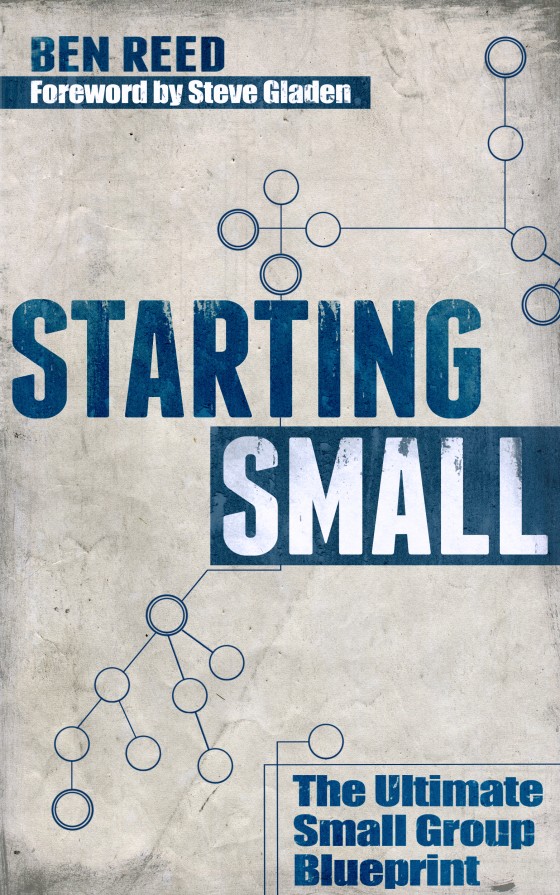
This is a series of posts where small group experts share how group life has impacted them personally.  The entire series can be found HERE.
Steve Gladen is the Pastor of Small Group Community at Saddleback Church. He oversees the strategic launch and development of their 3,500 adult small groups. His new book, Small Groups with Purpose, comes out in June 2011.  You can follow him on Twitter and Facebook.

_________________________________________________

Flashback with me to 1977. While most of the living population was born, probably the readers of this blog weren’t born (as painful as that is to say). I was a junior in high school. I was also a new follower of Christ. What was high school like for me? Was I an ESPN 150 Top Pick?

Not even close.

Getting ready to attend my first prom?

No again.

I was actually a late bloomer in many ways. A scholar?

Nope. I had to struggle just to get C’s and B’s. Luckily, gym class was always there to pull up my GPA!

But, surely, I was a sought-after young Christian leader, right?

Not even close.

When I think of what phrase might best describe me during this time, it is “in the background.” I was not a part of the in-crowd, the Who’s Who, the pretty people, or those who were invited to parties. And, worse yet, I had no ideas or the plans for the future. I was clueless. My dad was in business, so I had a vague notion that I would head down that path too. And that pretty much summed up my goals at the time. I enjoyed my life and basically just took it one day at a time.

The Story Begins

Enter a man named Ron Swiger. Ron was an adult in my church who took me under his wing without me ever realizing he was doing it. Our church didn’t have small groups, but they did have Sunday School and a Bus Ministry (Google it – it was a phenomenon in the 1970’s). That Sunday School functioned much like a small group. The Bus Ministry included serving and evangelism. Although the methodologies I use today are different, I realize, now, what a powerful role Ron played in my life.

Ron made sure I was involved and gave me a place to belong. He asked me to be an assistant in the Bus Ministry on his bus. He spent time with me. He did ministry in such a way that I wanted to be like him. He was also my Sunday School teacher. He was far ahead of his time and was a master at promoting growth in his students. He taught me to pray. He challenged me to give back to God. He taught the Bible in a relevant way.

Most importantly, he modeled what he taught. That Sunday School class was probably the best disguised small group of the day. We didn’t just learn biblical facts, we learned how to live life together. We had parties, interacted with the greater church, did outreach events together, and learned to challenge each other to deal with the dark areas of our heart.

Were we perfect?  No. Did I apply everything I learned to my life?  No. But did that class make an impact in my life? Yes!

A growing seed

When Ron stepped out of the role as my mentor, another man stepped in, Bill Brown.  God used him to build on the foundation Ron had started.  During those years of high school, despite my clueless nature, a seed was planted for ministry.  That seed would not bloom for almost 8 years, but it was still firmly planted.  And I owe a lot to those two men and others who had community with me.

What’s the moral of the story? When you look across the horizon of your church, you might not see the next young leader. You might just see a bunch of “clueless” people.

But don’t overlook them.

Because two guys were willing to pour into my life, I am where I am today. Community is where people are shaped for the future. Be willing to shape those God has put before you – not the ones you want to shape.

Has anyone invested in you?

Are you investing in the next generation?


The Sunday experience

My wife and I ate at a nice, swanky restaurant recently.

We felt like we were eating food that could be served on the Food Network.  Which is a far stretch from what we normally eat.  I learned what amuse bouche is (I had a pan-seared sea scallop with a slice of grapefruit, in warm vanilla sauce).  I had rillette and risotto…both of which I had to Google to know what they were.  The food was unbelievably good.

And as impressed as we were with the food, we were equally impressed with the service.  5 things stood out:

  1. We made our reservations online.  We’d never made online reservations for a restaurant before, but this process was incredibly easy.  We felt served even before we arrived at the restaurant.
  2. Our waitress was cross-trained.  She served our food, and could also talk us through the complimentary flavors, the local farms where they purchase their meat, and the precise way that each of our dishes was prepared.
  3. Our waitress wasn’t our only server…when we needed something, any server walking by would attend to our needs.
  4. I got up to use the restroom, and when I returned, my napkin was refolded and placed back on top of the table.
  5. The chef was feeling generous, and gave us a free tasting of his newest soup.

In short, it felt like the whole evening was about serving us, like we were truly honored guests.  And shouldn’t we be treated guests like that on Sunday morning in our churches?  Do we really offer that same level of service?  Because there are lessons to be learned here, whether your church is strong or weak when it comes to your Sunday morning experience.

Principles for serving on Sundays

  • Look for ways to surprise your guests with generosity. We paid a lot for our meal, but the fact that we felt served made us think less about the cost, and more about the experience.  And if “time is money,” then the people visiting your churches are “paying” a lot.  Make it worth their time.
  • Cross-train your volunteers and staff members. Our waitress cared about our entire experience, not just getting her tip.  And healthy team members know that, while their area of service may be primary for them, there’s a lot more that goes into a given person’s experience on Sundays than just their one area.
  • Serve relentlessly and creatively. The whole refolding-the-napkin-when-I-go-to-the-bathroom trick was awesome.  And it only took them 10 seconds.  But it took intentionality.  All of their servers had to keep an eye out for people who stood up to leave their table.  And that’s what it’s going to take to serve people on Sundays, too.
  • Prepared in advance to serve well. Serving with this level of class takes planning.  It doesn’t just happen naturally.  You, as staff and leaders, must plan ahead if you want your teams to serve well.  Brainstorming, dreaming, and mapping out action plans, is key if you want your guests to feel honored.
  • Know that Sundays aren’t the first, or last, impression. Our experience may have technically started when we arrived at the restaurant, but it certainly didn’t start, or end, there.  Taking this into account is important as you’re thinking through the message your church is conveying in your community and online.

Think, “What would this look and feel like for a first-time guest?”  Let that question propel you to creatively brainstorm with your team.

We’ve become raving fans of this restaurant.

Are you creating raving fans of your church?

What are you doing to creatively serve your guests?

 
Older posts Newer posts

© 2026

Theme by Anders NorenUp ↑