Tag: Leadership (page 12 of 13)

How do discipleship and mentoring play into small groups?

Here’s part 4 of my interview with Randall (on Twitter HERE), as a follow-up to his book, The Naked Truth of Small Group Ministry: When it Won’t Work and What to Do About It.  You can see part 1 HERE and part 2 HERE and part 3 HERE.

My question for Randall: How do discipleship and mentoring play into small groups?


Leader recruitment

Beware of placing such stringent restrictions on potential new leaders that you crowd out great individuals who can, and will, grow.

What are your requirement for small group leadership?


9 Ways to Increase Your Twitter Influence

Perform a Google Search for “How to Increase your Twitter Follwers” and you get plenty of websites/services to follow.

Many of these are services, where you opt in to following 10 people then auto-following everybody else back, guarantee that you’ll have 20,000 Twitter followers in 30 days.

Others give ways to buy Twitter followers.  I’m not kidding.  For only $87, this site will get you 1,000 new followers.

Other sites tell you things you need to do with your Twitter account, such as making sure to fill out your bio section, learning the language of Twitter (Reply, Retweet, Direct Message, hashtags, etc.), and following the people who update about things you want to read. (these are all good things, and should be done, but they’re not what I’m focusing on in this post)

But my goal in using Twitter isn’t to have more and more followers.

I would much rather have influence than followers.  Because followers often represent people who aren’t listening, but are merely speaking.  They don’t care anything about what you have to say…they just use Twitter as a platform to get the word out about their business/life/hobby.

If you want to increase your followers quickly, it will cost you $87.

If you want to build your influence, it’s a little tougher and takes longer.

(If you need a refresher on the language of Twitter, read my post HERE.  If you need some reasons to start Twittering, click HERE.  If you have no idea what Twitter is, click HERE.)

9 Ways to Increase your Twitter Influence

1. Be authentic. Give people a snapshot into who you are.  What makes you tick?  What do you enjoy?  What unique angle/wisdom can you give on an event that you’re attending?  A book that you’re reading?  A blog that you follow?

2. Share helpful content. If your posts only benefit you and your dog, people probably will tune out after a short period.  For example, I’m a small groups pastor, so I try to post content that applies in my field.  I try to be authentic, but I make sure the content is broadly applicable whether you live in Tennessee or California.  Whether you’re young or old.  Whether you go to my church or meet in a house church.

3. Invite conversation. Try to phrase some of your updates in a way that invites others to join in the conversation.  Pose a question.  Leave your update open where others can share their thoughts, opinions, and disagreements.  If it’s broadly applicable, helpful, and uniquely you, others will want to join in.

4. Post consistently. If you only post occasionally, people will tune out.  If you only post once/week, you’ll never show up in your follower’s timelines (because they’re based on the latest posts), and people will never see your updates.

5. Create conversation with others. I’m making a distinction here from #3, above.  Creating conversation means that you reply to others.  Retweet things you find important, inspirational, helpful.  Continue the dialog with others.

6. Don’t post only facts. When you have a conversation with someone, do you merely share facts with one another?  If you do, your friendship will quickly dry up.

7. Respond timely. If you’re consistently putting helpful information out there in a way that invites conversation, you will inevitably receive replies to your updates.  Make sure to thank those who are spreading your ideas.  And do it in a timely manner.  Also, if someone sends you a Direct Message, try as much as possible to respond in a timely manner (I use the 24-hour rule on any email sent to my inbox).

8. Give some link love. If you read an article, or a blog post, that you think may be of interest to others, share a link and give credit to the person that wrote it (by using their Twitter handle).  You may not see this as a way to boost your influence, but trust me…sharing links gives encouragement to others, and helps to give you credibility among those who follow you.

9. Be careful what you post. A tweet is forever.  What you post today will be visible for years to come.  Influencers have the future in mind with the things that they say and do.

Isn’t it the same in all of life?  Gaining influence is much more difficult than merely having a platform for your opinions.  You can go to the local mall and scream out your thoughts…but likely nobody will listen.

Working to gain the respect and trust of people is a much harder, and longer, process.

But in the end, I think it’s worth it.


Throw that bathwater out

Whether you’re a church leader, a business leader, a small group leader, or the leader of a local gang, you should constantly evaluate your system.

We just had a small groups launch yesterday at Grace Community Church.  10 new small groups launched, with over 150 people committing to joining new groups.  Amazing, right?!?

There’s room for improvement.

There was room for improvement last time we had Connect.

There was room for improvement this time.

  • We had more people indicate they wanted to attend the event than actually showed up.  That’s a problem.
  • We had people attend the event, but not actually sign up for a group.  That’s a problem.
  • We had people who needed to be in a small group, but neither showed interest nor showed up for the event.  That’s a problem.
  • We had people who showed up to the event, signed up for a group, but have already sent me an email and have dropped out.  That’s a problem.

I’m not a prophet, but I’m going to make a statement that will inevitably come true: There will be room for improvement next time.

We don’t allow these problems to cripple us, but rather we learn and grow from them.  Some we can’t help.  But others we can.

I’m willing to change the system, if that’s what’s needed, in order to more effectively carry out our vision.

As the old saying goes, “Don’t throw out the baby with the bathwater.”  But what’s often not said:

“Go ahead and throw out that bathwater.”


Sign Your Name on the Bathroom Wall

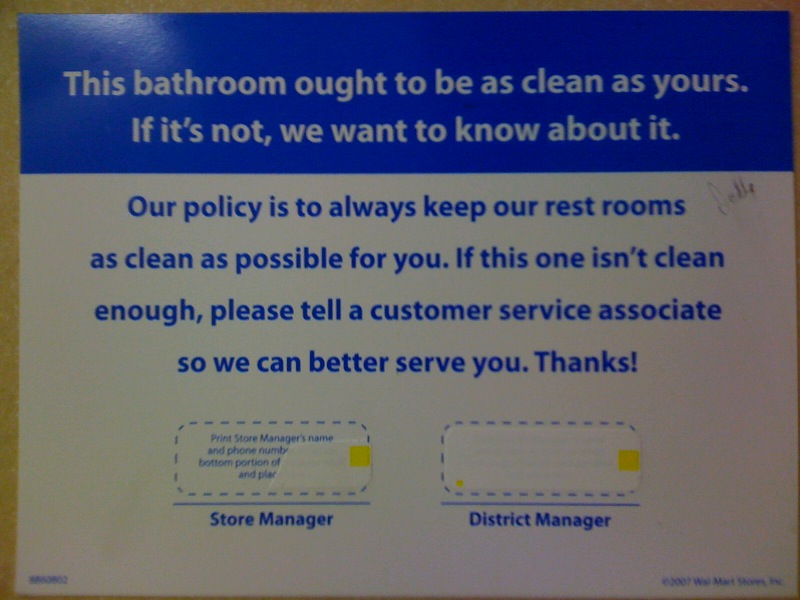
I was at a national discount superstore recently, and noticed this sign in the bathroom:

photo

I love the idea that proposed: if this bathroom’s not as clean as the one in your home, then there’s a problem.  The only thing wrong with the sign: neither the store manager, nor the district manager, give their contact information.

Do you believe in the mission of your organization enough that you are willing to take heat if the strategy isn’t accomplishing the goal?

Or are you so cowardly and closed-minded that you’ll give the perception that you’re open to suggestions, planning all along to respond only to the ones who agree with you?

If you don’t believe in the strategy of your organization, change it.

Then sign your name on the bathroom wall.


Leaders, Know Your Gifts, part 2

I’m in a series of posts of leadership strengths.  You can read the first post HERE.  Our staff took a test called Strengths Finder, and I’ll be posting my results, and subsequent personal thoughts, here on my blog.

I’ve got a word of caution about strengths.  Your strengths can become a curse when:

1. They’re used as a hammer.  There’s no reason to use your gifts to manipulate others.  God’s not pleased with that.

2. You assume everybody is gifted just like you. They’re not. And that’s a good thing.

3. When it’s the only lens through which you view leadership.  God has given you certain gifts, and you should use them.  But there are ways that He will stretch you, and situations in which your only course of action will be to rely on His strength.

God has gifted His church for the purpose of building up His bride (the church).  It astonishes me that He would use imperfect, weak men like me to build the church…but that’s His plan…and I know His plan is perfect.

Here’s the second strength that I tested into on my Strenghts Finder:

Achiever

People who are especially talented in the Achiever theme have a great deal of stamina and work hard. They take great satisfaction from being busy and productive.

Chances are good that you approach your work-related or academic assignments with a great deal of intensity. You are known for putting in long hours and working hard. It’s very likely that you tend to be quite selective about the company you keep. You prefer to spend time with individuals who are trustworthy. You consciously avoid people whose words and deeds indicate they value honesty less than you do. Because of your strengths, you exhibit a strong work ethic. Work probably gives your life a sense of purpose it would otherwise lack.
Instinctively, you argue that hard work influences the course of your life more than anything else. You make your own good fortune by preparing yourself to take advantage of opportunities as they arise. Each time you are successful, you can outline exactly what you did to reach a goal. You link together facts, incidents, conversations, or available resources to understand your accomplishments. You resist the notion that life is nothing more than a game of chance. By nature, you exhibit the physical and mental endurance needed to continuously toil long after others have stopped working. You are hardwired to pursue goals until they are reached. When obstacles arise, you become even more determined to succeed.

Do you find yourself described in this assessment?


Micro-managing

I’m a learner, at least according to Strengths Finder 2.0.  Here’s their description of one of my personality traits:

People who are especially talented in the Learner theme have a great desire to learn and want to continuously improve. In particular, the process of learning, rather than the outcome, excites them.

I’m constantly compiling and processing information.  I would be content reading and learning all day long.  Whether it’s books, blogs, podcasts, or asking good questions, I enjoy the process of learning and discovering new truths.  Because of that personality trait, some call me a nerd.

As I was compiling this mornings, I loved the post by Ron Edmondson at his blog, Graced Again.  He highlighted the effects on various people when the constraints of micromanagement are removed.  I also watched this video, posted by The Soderquist Center:

‘LeaderSkilz’ Pilot Episode from The Soderquist Center on Vimeo.

So, my question to you is this:

Are you a micromanager?  Is that working for those you’re leading?


Do You Have a Vision Problem?

Keep Out!I visited a church recently, and found it to be less than friendly.  In fact, we felt like we were outsiders.
They used lots of “insider” language, barely acknowledged that visitors were even present, and talked about situations that one would only know about if he or she were a regular attender.

The problem, as I saw it, wasn’t a lack of volunteers.  It wasn’t even a lack of skilled volunteers.  There were plenty of capable folks who could have made us feel warm and welcomed.

The problem wasn’t that the pastor and leaders couldn’t communicate in such a way that first-timers could get it.

The problem wasn’t a lack of organization on the part of the leadership and the “welcome” committee.

The problem is that they didn’t want to.

By not communicating the importance of welcoming outsiders, they had structured their service in such a way that those who are new felt awkward, unwelcomed, and ultimately unwanted.

People want to be led.  They’ll be led where the leader takes them.

If there’s a problem with vitally important tasks consistently not being carried out, maybe the finger needs to be pointed at you, the leader.

Are you regularly casting vision for those things that are most important? Where are you taking those you’re leading?


Bad Chicken

On Monday morning, I had some leftover chicken that I brought to work with me.  My arms were full when I got out of the truck to walk into the office, and I inadvertently forgot the chicken.  3 hours later, I realized my mistake, walked out to the truck to get it, and came back inside to put it in our refrigerator.  I ended up having lunch plans on Monday, so I left it in the fridge until yesterday.

I was really hungry, and the thought of grilled chicken made my mouth water.  30 minutes after I had finished it, my mouth was far from watering.  My stomach was messed up!  In the 3 short hours the chicken hung out in my hot truck, it had spoiled.  It tasted good going down, but soon had its revenge.

In your church, or business, or organization, are you set up to move swiftly on ideas that fit within your mission and vision? Or are you set up in such a hierarchical pyramid that, even if an idea is brilliant, it takes months, or even years, to move forward with it? Or maybe you’re so locked into a certain way of fulfilling the strategy of your company that you can’t see the value of a new idea.  Good ideas can go bad quickly when they’re not acted upon.

At one point, that chicken would have been a great choice for lunch.  But left in the truck, it spoiled.


Get out of the Box

This past weekend, Laura, my wife, and I traveled to Atlanta, GA, to visit with small groups pastor Scott Mawdesley, who was generous enough to give us a tour of North Point Community Church and allow us to ask lots of questions about what they do and why they do it.  We also got to visit Buckhead Church on Sunday morning.  The entire weekend was a great experience.

Whatever you do for a living, I would strongly suggest getting out of your normal environment.  Plan a day, a weekend, or even an entire week, to get away and learn from somebody else in a related field.  Here are 3 reasons why I think you desperately need this:

1. We migrate to tunnel-vision. Over time, you begin to think that you have the market on all of the great ideas.  Well, you don’t.  Trust me.  You may have lots of good ideas, but not all of them.

2. Evaluation naturally declines when you’re in the same box for an extended amount of time. Think with me for a minute.  If you’re literally in a box for a month, you might be in evaluation mode for a week or two.  Then, you begin to think that you’ve evaluated everything.  And probably, you have.  It’s only when you get into another person’s box that you see that your box is in need of repair.  Seeing other systems helps you to evaluate holes in your own.

3. Leading an organization (or a small group) can lead to burnout. Visiting other sites, and taking a break from wearing the “leader” hat, is refreshing, and needed on a regular basis.  Getting out of your box allows you to take a deep breath and relax.

So here’s my question for you:

Have you taken a break from leading and visited another business/small group/church?  What did you learn?

 
Older posts Newer posts

© 2026

Theme by Anders NorenUp ↑