Archive - August, 2009

Attention all Dads!

Check out this video. (sorry, I’m having trouble embedding videos onto my blog, so I had to provide a link)

My son is only 10 months old, but I can already see that he loves it when I show him that I’m proud of what he’s done.  He beams with pride when I am excited about his accomplishments.

Children need their parents’ support.  They need us to be proud of their achievements.  They need us to get down in the dirt and play.  Be made to look silly sometimes.  Sacrifice time, resources, energy, and our free time…to attend one of their games…one of their dance competitions…to play in the back yard…to teach them how to ride a bike…how to drive a car.  In short, they need us to love them.

Isn’t that what God did?

Do nothing out of selfish ambition or vain conceit, but in humility consider others better than yourselves. Each of you should look not only to your own interests, but also to the interests of others.Your attitude should be the same as that of Christ Jesus:
Who, being in very nature God,
did not consider equality with God something to be grasped,
but made himself nothing,
taking the very nature of a servant,
being made in human likeness.
And being found in appearance as a man,
he humbled himself
and became obedient to death—
even death on a cross!
Therefore God exalted him to the highest place
and gave him the name that is above every name,
that at the name of Jesus every knee should bow,
in heaven and on earth and under the earth,
and every tongue confess that Jesus Christ is Lord,
to the glory of God the Father.  –Philippians 2:3-11


Bad Chicken

On Monday morning, I had some leftover chicken that I brought to work with me.  My arms were full when I got out of the truck to walk into the office, and I inadvertently forgot the chicken.  3 hours later, I realized my mistake, walked out to the truck to get it, and came back inside to put it in our refrigerator.  I ended up having lunch plans on Monday, so I left it in the fridge until yesterday.

I was really hungry, and the thought of grilled chicken made my mouth water.  30 minutes after I had finished it, my mouth was far from watering.  My stomach was messed up!  In the 3 short hours the chicken hung out in my hot truck, it had spoiled.  It tasted good going down, but soon had its revenge.

In your church, or business, or organization, are you set up to move swiftly on ideas that fit within your mission and vision? Or are you set up in such a hierarchical pyramid that, even if an idea is brilliant, it takes months, or even years, to move forward with it? Or maybe you’re so locked into a certain way of fulfilling the strategy of your company that you can’t see the value of a new idea.  Good ideas can go bad quickly when they’re not acted upon.

At one point, that chicken would have been a great choice for lunch.  But left in the truck, it spoiled.


Sunday Morning

I’m blessed to serve at Grace Community Church.  Seriously, I’m blessed like crazy.  They took a chance on a young guy like me, even before I was done with seminary.  Hopefully, it’s not one they are regretting now!  I’m given freedom to try new things and experiment with different ideas in ministry, all with the hope that more of Clarksville might fall in love with Jesus.  I’m also given direction and shepherding as a young leader, which I desperately want and need.  Seminary was great, don’t get me wrong…but it didn’t prepare me for all that I would encounter in ministry.  The team that I serve with here is so supportive, and I love serving with them.

If you’re not a part of Grace, let me introduce you to Chad Rowland (aka @chadrowland, if you’re on twitter).  The guy’s a phenom.  I’m wowed every time he preaches.  He’s a masterful storyteller (before you brand me as a heretic for praising him as a storyteller and not as a “preacher” or “pastor,” don’t forget that Scripture is the story of God’s redeeming his people…that’s right, isn’t it?), having me on the edge of my seat one minute as he shares a story, laughing the next, and floored by the Truth the very next.  Yesterday was no exception.  He was able to cast the vision for who we are as a church, our three-fold strategy for making growing followers of Christ, and talk about money, the easiest, most comfortable topic to address ever…it was a ton to cover in a short amount of time, but as always, Chad did it with much precision and wisdom.  God’s using him in amazing ways at Grace.

[vodpod id=Groupvideo.3217610&w=425&h=350&fv=channelID%3D100000273]

more about “TruthCasting“, posted with vodpod
 

The Language of Twitter

New to Twitter, and wondering what all of this different terminology means?  Been using it a while and still unsure?  Haven’t even bought in to Twitter yet, but wondering why people’s Facebook updates have crazy letters and symbols attached to them?  I get asked a lot of questions about Twitter, so here’s a crash course that may help you out.

Ever seen something like this on a person’s Facebook update?

Picture 2What’s the deal with the RT?  Why start somebody’s name with the @ symbol?

There’s a whole language that’s developing with Twitter that, if you don’t know it, will leave you behind.  Some of the language is built into the software, and some is developing organically, but all of it is foreign to you if you haven’t used it before.

A Guide to the Language of Twitter

1. Tweet – a tweet is your status update.  Every time you post something to your twitter account, it’s considered a “tweet.”  Sounds cheesy, I know.  Their language, not mine.  The goal is to answer the question, “What are you doing right now?”

2. Follow – if you want to receive people’s “tweets” when they update, you “follow” them.  Sounds kind of creepy, but really it’s not.  You have the option, when you follow them, of receiving their updates either via your mobile phone (Twitter utilizes SMS) or solely on your computer.  If you choose to receive them on your mobile phone, then every time they “tweet,” you will receive a text message.

3. @reply – When you sign up for Twitter, you create a username.  Mine happens to be @benreed.  Your username is, of course, attached to your account, and anybody who knows your username can find your Twitter account.  It’s as simple as going to http://www.twitter.com/________.  The @ reply comes in when I want to mention somebody in my update.  If I say something like this…

Picture 4…then you know exactly who I was talking about.  In fact, when I “mention” somebody by starting their username with @, their name shows up as a hyperlink that others can click on, seeing who really messed up some mac & cheese (see @steph_underwood’s update above)!

4. RT – This is shorthand for “ReTweet.”  A “tweet” is an update that you post, either via your mobile phone (Twitter utilizes SMS) or your computer.  If you read somebody’s update, and like it, and want to share it with those who follow you on Twitter, thus creating a “viral” message, you can “ReTweet” it.  Think of it as a mass FWD that you want to share with others…except this one is much shorter than those you receive in your email inbox.  Here’s what I mean:

Picture 5So, as you can see, I “ReTweeted” the post of Cary Branscum.  You can quickly know it’s the famed Cary Branscum, from http://caryperks.wordpress.com, by clikcing on the hyperlink created when I started his username with @.  Still follow?

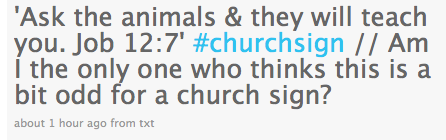
5. # (hashtags) – Though some people espouse that Twitter is a mass of one-way conversations with nobody, I don’t find that to be true.  Hashtags are a great example of how Twitter opens up dialog and creates networking conversations.  Here’s what I’m talking about:

picture-62

Hashtags help you to categorize ideas and topics.  So, although reading lots of different church signs may not be the highlight of your day, when I preceded the word “churchsign” with a “#,” it unites me with everybody else who is posting about church signs, making it a searchable topic.

6. DM – this is shorthand for “direct message.”  This is a message sent privately to only one person, in contrast to an @ reply (also known as a “mention”), which is broadcast as public information.  To send a direct message to a person, simply start your update with the letter ‘d,’ followed by the person’s username.  The message is then sent to that person and only that person.

The language of Twitter will continue to develop and grow.  This is a list of the basics as they stand right now.  Are there any I left out?


“Your Jesus is Too Safe” Review

Have you ever seen a “Buddy Jesus”?  I remember seeing one for the first time on a shelf, and finding myself both laughing hysterically and being utterly disguisted at the same time.  I mean…seriously…who thinks of these kinds of things?

9780825439315In Jared Wilson’s book, Your Jesus is Too Safe, he confronts head-on the idols that we have made out of Jesus.  Not always physical, Buddy Jesus idols, but dangerous, joy-robbing, and soul-stealing nonetheless.  You may be worshiping a false Jesus and not even know it.  Scary, right?

I had a conversation just the other day with a person who said (sorry, I won’t tell you what church they go to), “It’s fine that some people follow Christ, and find God through him.  But others find God through many different paths.  And some people don’t call Him God.  They may call Him ‘purpose,’ or ‘science’ or ‘energy.’”  There’s not enough room to address each of these here, but suffice it to say that if you don’t know the Jesus of the Bible, you don’t know God. (John 14:6-9)  And Wilson clearly lays out who the Jesus of Scripture is.

Who is Jared Wilson? Think: John Piper meets Mark Driscoll meets Matt Chandler meets your-best-friend-who-shoots-straight-with-you-and-doesn’t-feel-bad-about-it.  I was struck by the accessibility of Wison’s theology.  His dry wit makes theology fun and inviting (as it should be).  Stuffy professors have the tendency to teach a dry, lofty, intellectual theology.  I’ve been through seminary.  I’ve read the books (well…most of them).  This would have been one of my favorites.  He brings theology to the level where most of us operate, and will make you laugh while he’s explaining things that are so often alliterated with 4 J’s…or O’s…or Q’s.  Instead of dozing off because you’re bored, you’ll find yourself drawn into knowing more and more about the true Jesus.

Who do you say that Jesus is? (p. 264)

I wanted to ask Jared a few questions so you could get to know him, his heart, and his wit just a little bit more, and hopefully be compelled to pick up a copy of his book.

1. The whole premise of your book is that the Jesus we are following is not the Jesus of the Bible.  That is offensive to some people, because basically you’re telling them that they’re believing and following the wrong Jesus.  How might somebody know that they’re following the wrong Jesus?

When you wake up and it turns out Jesus likes and dislikes the same things and people you do, you’re Jesus is too safe.
Or, if you read what he said and did in the Gospels and never think either a) That freaking scares me to death, or b) That blows me away, you’re Jesus is too safe.
If knowing the cost he paid for the debt we owed never thrills and breaks us, he’s too safe.

2.  Why is it that we are so easily duped into believing and following false Jesuses?

Short answer is sin, of course. The long answer is that we are always worshiping. That “worship” switch inside us is never flipped to the Off position, so we just keep worshiping, keep moving like sharks in the ocean. So because we’re still exercising the worship impulse — and we’re going to church each Sunday — we think we’re worshiping Jesus, when really we could be worshiping our own self-esteem or the approval of others or success in our life or comfort or convenience or whatever, but it all has a Jesus sheen on it.
We drift into idolatry easily and quickly and subtly. This is why God is constantly spanking the Israelites. It just happens. And it just happens to us because idolatry is in our hearts.

3. Too safe?  My Jesus is “too safe?”  What does safety have to do with anything?

Because “Deny yourself, take up your cross, and follow me” is the epitome (x3) of danger.

4.  Your humor regularly comes through in the book.  Isn’t theology one of those things we should be more serious about?

Yes. I tried to make the humor in the book more the window dressing than the furniture in the room, and further, to have it more about taking ourselves less seriously and God moreso. But I’m also a sarcastic dork, so I couldn’t write it and not have that come out.

5.  You talk a lot about who Jesus is in the book.  Does it really matter what we believe?  I mean, shouldn’t Christians be all about “doing” and stop “thinking” so much?

Yes, if you think there won’t be people who say to Jesus at the judgment “We did x, y, and z for you” to whom he says in response, “I have no idea who you are.”
The “doing without thinking” thing is precisely what leads to self-righteousness.
This week I’ve begun a series through Colossians at our church, and one thing that has sort of struck me for the first time as I prepare, is that Paul’s letters, which are full of practical exhortations and behavioristic commands, nearly always begin with some hard core doxological proclamation of the gospel. Philippians has it, Ephesians has it, Colossians has it. And it’s sort of like, for Paul’s writing, the gospel is huge at the introduction in order to provide the momentum for the hills and valleys of the practical stuff. The gospel has to be the thing that pushes us, propels us, carries us through, like the first big drop of a roller coaster. Or else we end up thinking life is all about the little “doings” and, worse, that we’re doing those “doings” under our own power.

6.  When you wrote this book, did you write it for mature believers, immature believers, seekers, children, adults?  Who was your target audience?

It’s for people who need to hear about Jesus and the gospel, which I think is everyone, Christian and non. But I know you’re not supposed to market a book that broadly.

The book does assume a certain working level of Christianity, and it does sort of assume that the reader is interested in deepening his or her understanding of what Jesus said and did. It assumes the reader has “a Jesus” that may or may not need clarifying.

And given the pop cultural references, the humorous footnotes and the sarcasm and what-not, it is probably most in the language of Christians 18-40 or so.

7.  Have you found yourself ever following a “safe” Jesus?

Yes. For the first 30 years of my life without knowing it. And then every day for the last 3 years or so, except now when I do it, I usually know that I am.

8.  The Bible is the greatest selling book of all time.  Do you think “Your Jesus is too Safe” will eclipse the Bible’s sales?  How soon do you predict that will happen?

By my calculations, it will be sometime in 2013, but since the apocalypse foretold by the Mayan Calendar occurs before that, I won’t get to do any blasphemous victory dances.

For more reviews of Your Jesus Is Too Safe, and additional interviews with the author Jared Wilson, please visit Jared Wilson’s blog, The Gospel-Driven Church, for blog tour links.


 

Desensitization

It’s easy to become desensitized. We become less sensitive to things in a very short period of time.

The more often you drink caffeine, the less effect it has on you.

The more often you eat out, the less special it becomes.

Drive the same route to work every day, and you can almost get there with your eyes closed.

Laura and I watched a movie with some friends last night.  It’s not one I’m all that proud that we saw (though I did enjoy being with good friends).  The language was absolutely pitiful.  I think I heard the “f” word more in that movie than I have in my entire life.  There was more coarse talk in that movie than my grandparents have heard in their lifetime.  Seriously.  It was embarassingly crude.  At first, my sensors were turned up really high.  It’s as if every curse word stood out like a sore thumb, and every lewd statement made the screen flash “red alert” to my ears.  But by the end of the movie, I could almost look past those words.  Not that I would excuse them, but after over 2 hours of it, I had become desensitized.  I almost didn’t even hear the foul language, looking past it to see the storyline and character development.

Isn’t it the same way with sin?  The more we give in to sin, the more it feels normal?  The more it begins to feel like a natural part of life.  “This is just who I am…” “This is how God created me…” “I can’t help what I do…” “It just feels right…”  We easily fall into the trap of being desensitized to sin.

We need to wake up.  God is doing miraculous things around us, through us, and for us each and every day.  He gives us life.  He makes the wind blow.  He works salvation.  And He wants what’s best for you (well…He wants what’s best for Him (see Isaiah 43:7), which is what is best for us).

Do you hate your sin, or do you find yourself gravitating towards it time and time again?  Maybe you need a change of scenery.  Maybe you need to spend more time with the Lord and less watching TV.  Maybe you need to spend time building community with others instead of returning again to your vomit (sorry, that was a bit explicit…but that’s what Proverbs says).

I join you in this fight.  I’m so easily led astray.  I’m too easily desensitized.

And do this, understanding the present time. The hour has come for you to wake up from your slumber, because our salvation is nearer now than when we first believed. The night is nearly over; the day is almost here. So let us put aside the deeds of darkness and put on the armor of light. -Romans 13:11-12


How NOT to lead a small group

Listening is an important aspect of leading a small group.  I even mentioned it in a recent post HERE.  Actively listening, asking appropriate follow-up questions, noticing body language, and helping people understand the heart of the issue being discussed are all part of facilitating discussion in a small group environment.

If you desire to be a good small group leader, you must work on your listening skills.

Obviously, listening isn’t the only thing that a small group leader needs to be able to do, but I believe that it is a vital skill that group leaders must learn.  Check out this video.  It’s a great example of somebody who does not really listen, does not ask appropriate questions, offends with statements and questions, and quickly judges based on partial information.  Enjoy!

[vodpod id=Groupvideo.3069567&w=425&h=350&fv=]


Saturday fun

I’m all for a good laugh.  If this video doesn’t make you laugh, or even if it does, you should join us tomorrow morning at Grace Community Church.  Expect to see nothing like this:

[youtube=http://www.youtube.com/watch?v=GfAglGilQBQ&hl=en&fs=1&rel=0]