Month: March 2010 (page 1 of 2)

Advertisements and Evangelism

I’m reading through The Tangible Kingdom: Creating Incarnational Community by Halter and Smay.  Thought this quote might challenge some folks:

Advertisements by their very nature are intended to coerce thinking and behavior.  They are neded when there is no personal relationship between the seller and the potential buyer.  This type of coercion is expected when you’re trying to decide what beer to drink or car to buy, but it’s highly offensive when people try to tell you important truths without any tangible relationship.

[…] Paul shares his insights on posture [the nonverbal forms of communication that accompany what we say] with those who were coming to faith in 1 Thessalonians 2:7-8, “But we were gentle among you, like a mother caring for her little children.  We love you so much that we were delighted to share with you not only the gospel of God but our lives as well, because you had become so dear to us.”  An expanded paraphrase might be, “Because we found ourselves emotionally attached to you all, we couldn’t just preach at you.  We knew you needed time to process your faith, and the only way to help you understand the big picture was to stay with you longer.  We knew the message would make more sense if you saw it lived out in our lives.”      –pp. 40-41

When you think of “sharing your faith,” does your mind immediately go towards speaking?  Or do you think about doing life together with people?


A Healthy Small Group…

I recently said this on Twitter:

So many problems in life could be solved by a healthy small group.

The responses I received really made me think about what components go into producing a “healthy” small group.

A “healthy” small group is one that accomplishes “the win” for your system.  Which means that a healthy group at our church may look a little different than the one at your church.  And that’s ok.  Step 1 is defining “the win.”

But there are certain things that “winning groups” do, right?  Do you encourage those things?

Here are a few that I’ve come up with for our system.

A healthy small group…

…stirs your heart to action.

…helps remind you who you are in Christ.

…helps you realize the all-encompassing nature of the Gospel.

…pursues unity.

…is full of people taking steps of faith…together.

…helps you realize the fullness of Grace.

…helps remind you that the troubles in this life will one day be over.

doesn’t wait until the group meeting to speak encouragement to one another.

…shares group responsibilities with each other.

…relies on each other when needs arise.

…isn’t satisfied with surface-level prayer requests.

…serves others.

…serves each other.

…has fun together.

…laughs together.

…gives people safe space to explore their faith.

…is a safe space for non-believers.

What would you add to the list?


Jason Harpst, an interview

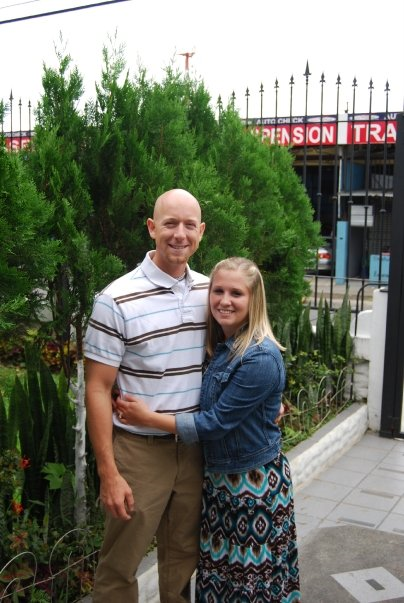
Jason and Kerby Harpst go to Grace.  They’re small group leaders.  They’re key volunteers in Grace Acres.  And we’re sending them out, to Costa Rica, in June.  To be honest with you, they’ve become such a vital part of Grace that we hate to see them go.  However, we rejoice with them as they are following God’s lead and leaving life as they know it in America.  If you haven’t met Jason and Kerby, I hope you get to one day.  Until then, I thought I’d post some questions to help you get to know them.

1. Where are you going in Costa Rica?
We are going to the small town of Villas de Ayarco, which is in the mountains about 45 minutes southeast of the capital city of San Jose.

2. What will you be doing while you’re there?
We will initially work with short term teams that come to Costa Rica as the Volunteer Team Coordinators for the Abraham Project.  We will also work with the children that live in any of the three orphan homes that are part of the Abraham Project.  Our vision is to set up a sports outreach program for the children and teens of the local community, where the average family lives at the “extreme poverty” level.

3. Why Costa Rica?
Costa Rica is a place we have both visited before and we saw a great need for our help.  The Abraham Project, in particular, is in need of help to expand on their vision and to reach more of the hurting people of Costa Rica through the love of Christ.  With such a high cost of living, so many of the people cannot afford food for their children everyday and the local communities are filled with drugs, prostitution and gang activities.  It is too easy for young children to get involved in these activities that are all too common for them.  If they have an alternative choice to devote their time, such as a sports program that is based in the love and need for Christ in their lives, then they have a bright future…spiritually and socially.

4. Do you see this as a temporary thing, or something more permanent?
This is a permanent move.  As we surrender to God’s calling, we feel this is a permanent move.  Not a permanent move to Costa Rica in a sense, but a life devoted to what ever God has planned for us.  Where ever He leads us in the future, we will follow in effort to reach more people around the world for Christ and expand His Kingdom.

5. What did you do prior to committing to going to Costa Rica?
I have my Bachelor’s and Master’s degrees in Mechanical Engineering and I have worked for both the Trane Company and General Motors Corporation.  My wife, Kerby, is finishing her degree in Special Education this spring.

6. Why not continue doing that?
To be honest, it would be easy to continue my work as an engineer and having Kerby work as a school teacher.  We could live comfortable lives and have a great place to raise a family in the United States but that would be our plans not God’s plans.  God has specifically asked us to give that up, and go share our love and hope we have in Him.  God calls everyone to a different path in his plan to spread the great news of Christ; some are called to only short term mission trips, some are called to support full time missionaries, some are called for local missions, and some are called to go as full time missionaries overseas.  For us, we fit into His plan as a family that will go and tell people about Christ.  It will not be easy, but we know God will provide for our needs.

7. Have you been to Costa Rica before?
I have been to Costa Rica seven times.  Six times for short term mission trips and once in January for a “pre-moving” trip and to meet with the pastor and others we will work along side with at the Abraham Project.  Kerby has been to Costa Rica twice before.

8. How do you feel uniquely gifted for what God’s calling you to do in Costa Rica?
As an engineer I am very organized which will help in the Team Coordinator aspect of our work in Costa Rica.  Additionally, Kerby will be teaching English in the daycare center at the orphanage.  With her specialty in Special Education, it will benefit her greatly when working with these children with physical and social disabilities.  We have also spent the past three years working with the children of Grace Community Church each Sunday in Grace Acres.  As far as being “qualified” to be full time missionaries, we are not, but I don’t know if anyone is really qualified.  We firmly believe in what many international mission organizations are based on.  God does not call the equipped, but instead, He equips the called.  We have much to learn about being missionaries, but our focus is on serving our all powerful and wonderful God and sharing with others what He has done in our lives.

9. What are some challenges you’ve already faced in preparing to become a full-time vocational missionary in Costa Rica?
One of the biggest challenges is seeking financial support.  We are not affiliated with any international missions agency so we need to raise 100% of our financial support.  Costa Rica has a high cost of living; where a simple $8 Wal-Mart coffee maker here in the United States costs over $30 in Costa Rica.  By not receiving any of our financial support from a missions organization, our support will come strictly from friends, family members, fellow church members, or anyone else that shares our hearts for Costa Rica.  We have had other small struggles since making the decision to enter the mission field about five months ago, but it has been amazing to see how God works and we have seen first hand what He can do if our plans are aligned with His plans.

10. What is your biggest need right now?  Is there a way we can help?
We need monthly supporters.  We have a few individuals that have been very committed to supporting us financially and we cannot express how thankful we are to have them partner alongside us.  We leave for Costa Rica at the beginning of June and what we really need right now are individuals that can commit to supporting us each month.  Nothing is too small or too big.  If you would like to support us, you can send a tax deductible check to “Grace Community Church” with a note of “Costa Rica” or “Jason and Kerby” to the following address.

Grace Community Church
PO Box 3980
Clarksville, TN  37043

You can follow us on our blog at www.todalagentecr.blogspot.com and you can always email us with questions or for more information at todalagentecr@gmail.com.


Serving others

What organizations are you most proud to support/serve right now?

Here are mine:

Grace Community Church – Love my church!

Africa For Jesus – Ryan has single handedly changed the way I think about global missions.

Mission Clarksville – Patrick and Catherine Smith have launched this organization in Clarksville with the aim of giving meaningful, rigorous work to local students from each of the high schools…for the purpose of investing and maturing them.

Manna Cafe – Kenny York is bringing his passion and giftings with ministering to the homeless community to Clarksville.  Instead of asking the homeless to come to a central location, Kenny will be traveling (with hot meals) to them, aiming to meet physical and spiritual needs.

Leave a comment, and let everybody know what organizations you believe in!


Encouraging Criticism

Hate Twitter all you want, but, like I’ve said HERE, I find great value in it.  I recently said this after a visit to Lasaters Coffee, a local shop here in Clarksville:

Disappointed that the @lasaterscoffee workers couldn’t serve me a press pot of coffee bc they didn’t know what it was 3:37 PM Dec 2nd

I received this reply from them…directly to me:

@benreed We will be serving coffee via French Press before you know it!! Keep an eye on the website and in the stores:) 10:04 AM Dec 4th from TweetDeck in reply to benreed

Knowing how, and when, to respond to critics is very important.  I applaud Lasaters for their timely and effective response.  Because of that response, they’ll get more business from me.

A critique of the system you’re leading can often feel like a personal attack.

But in the end, critiques can help to improve the overall effectiveness of the ministry.

Maybe a person’s critique is off-base.  Out of line.  Out of touch.  Off-color.  Off-putting.  Off-handed.  Offensive.  Biting.  Reactionary.  Untruthful.  Unholy.  Discouraging.  Poorly timed.  Poorly executed.  Or all of the above combined.

But most critiques have at least a shred of truth.

May we, as leaders in our respective organizations, be humble enough to continually evaluate our system.

How do you encourage open, honest evaluation of your system?


Missional DOES NOT = Comfortable

Being missional is God’s charge to the Church.  And being comfortable isn’t part of that plan.

For the whole sermon, click HERE.


Cultivating the drone

Do you celebrate volunteers who do exactly what you ask them to do?

Or do you encourage creativity, outside-the-box thinking, and pursuing God-given passions?

Teaching people to punch a button is easy.  Raising up (and giving space to) leaders who are creative and innovative is not.

Raising up creative leaders is:

1. Messy – When you ask somebody to think outside of the box, it ceases to be “clean, concise, and manageable.”

2. Decentralized – It’s difficult to have a two-hour training on this stuff.  It’s more about cultivating an environment than about transferring information.  And allowing creativity to permeate each person (rather than having those you lead simply parrot back a response) means that you won’t be the sole trainer.

3. Slow – Since it’s not chiefly about transferring information, it takes much longer.

4. Difficult to replicate – Many times, this process differs from person to person.  Creativity is unique to the individual, and thus not exactly duplicate-able.

5. Risky – Asking people to think outside the box means that they may go off in a direction that you didn’t intend.

However, I think that it’s worth dealing with each of the above.  Because in the long run, organizations that embrace and encourage creativity will produce innovators who work through plaguing problems, promote development, and help a company (or a church) sustain long-term growth.

If you’re content doing things the same way you’ve always done them, then you’re going to raise up leaders with that same value.


The power of your story

You have a story.

It may be ugly and offensive.

It may be neat and pretty.

It may be rough and unfinished.

And you’re probably scared to share it, because of what people will think when they hear it.

But sharing your story within community is one of the most powerful things you can do to build community.

I recently shared my story with my small group.

And let me tell you…it felt great.

To have people intently listening to my life story, nod their head in understanding, ask probing questions, and affirm God’s work in my life felt so freeing.

And confirmed to me the value of my story.

You have a story.

And the beautiful part is that God’s still working on you.

Will you consider building community around sharing your story and listening to others’ stories?


How to launch a small groups system

Here is the 5th, and final, installment of my interview with Randall Neighbour (on Twitter HERE), as a follow-up to his book, The Naked Truth of Small Group Ministry: When it Won’t Work and What to Do About It.  You can see part 1 HERE, part 2 HERE, part 3 HERE, and part 4 HERE.

My final question for Randall: What is the best way to launch a small groups system?


How do discipleship and mentoring play into small groups?

Here’s part 4 of my interview with Randall (on Twitter HERE), as a follow-up to his book, The Naked Truth of Small Group Ministry: When it Won’t Work and What to Do About It.  You can see part 1 HERE and part 2 HERE and part 3 HERE.

My question for Randall: How do discipleship and mentoring play into small groups?

 
Older posts

© 2026

Theme by Anders NorenUp ↑