If you’d like to catch up on this 11-word series, click HERE.

Every
tear,
laugh,
relationship,
dream,
failure
step
is valuable.
Treasure them.
(See James 1:17)

If you’d like to catch up on this 11-word series, click HERE.
Every
tear,
laugh,
relationship,
dream,
failure
step
is valuable.
Treasure them.
(See James 1:17)
____________________________________________…
Because sometimes listening and weeping is more valuable than words you can muster up.
(see Job 2:11-13)
Michael McKinley wrote this on the 9Marks Blog:
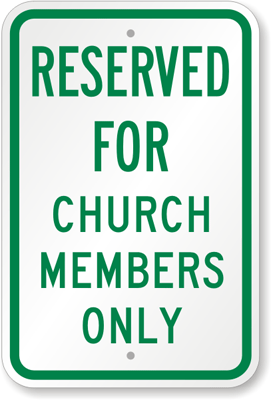
So in our church, non-members are welcome to attend and participate in the public services of the church. We are happy to have them in our Sunday morning gathering, our Sunday evening gathering, and our fellowship meals.
But we don’t let people attend small groups…until they are members.
This statement shocks me, and runs countercultural to what we, as a church are trying to accomplish. We never want to exclude new folks from being a part of our small groups, because we believe that the best way to get connected, grow in your faith, and become a disciple of Christ is in the context of small groups.
If we were to exclude visitors from linking up with small groups, we would, in effect, be saying that we value church membership over discipleship.
I’m not ready to make a statement like that.
Discipleship doesn’t start when you become a church member.
But maybe I’m wrong.
What do you think?
Should visitors be excluded from small groups, until they become members?

He had been pulling up and cruising for a few weeks prior, so we knew he was just about ready to start letting go and walking on his own. My wife and I were sitting across from each other in the middle of the living room floor, and I stood Rex up in between us. He could barely get his balance. In fact, he was so wobbly he fell down before he even got started. So I stood him back up.
Then it happened.
He took a small step, then started to fall forward. Just before he reached the point of no return (where he would fall flat on his face), he stuck his other foot out in front of himself. His momentum carried him forward, and he forgot to put his other foot out in front, so he fell face first into my wife, who, along with me, clapped and cheered for our son. He had started to walk!
So we stood him up again, and he tried once more. Then he fell. And smiled.
So we stood him up again, and he tried once more. Then he fell. And smiled.
So we stood him up again, and he tried once more. Then he fell. And smiled.
Then he got tired, so we quit for the day.
Notice this: he wasn’t so hard on himself that he wouldn’t try again.
Part of the hindrance to our spiritual growth is that we’re too hard on ourselves. We beat ourselves up over and over again, when we’ve got a Father who, while we’re still a long way off, is filled with compassion for us, and is running towards us so He can throw His arms around us and kiss us. (Luke 15:20-21)
We, like the Prodigal Son, still beat ourselves up. We respond, “Father, I have sinned against heaven and against you. I am no longer worthy to be called your son.” (Luke 15:20)
To which our Father says, “Let’s celebrate!” (Luke 15:23)
I’m not saying that we should act like we’re perfect, and can do nothing wrong. But I am saying that we should not be so paralyzed in our sin that we don’t take another step forwards, towards our Father who’s running our way. We could live in the reality that we’re sinners who are “no longer worthy to be called your son.” But wallowing in our guilt and shame doesn’t help us move towards God.
Maybe we should start reminding ourselves that our Father is cranking up the music, getting His dancing on, and grilling up a feast for us. Because He loves us that much.
Do you ever find that you’re too hard on yourself?
Is it time to give yourself a break, and celebrate even a small step in the right direction?
Do you know someone who needs to be reminded of this truth?

(image by ArtMoth.com)
I remember when I didn’t make the varsity baseball team in high school. I was crushed. But through that, I ended up quitting baseball to pursue golf, a sport I turned out to be pretty good at.
In seminary, I absolutely bombed a paper that I thought was one of my better projects. Through that, I worked hard to refine my writing, and in the process, found a great love of writing.
The first small group my wife and I were a part of (in Louisville, KY) was an abysmal failure. I didn’t want that to happen to us, or anyone else, again. Now I’m a small groups pastor.
The New Testament Church was led by a guy named Peter. Don’t forget that he had an epic fail, where his pride was kicked in the teeth. He thought he was ready to die for Jesus. He wasn’t (John 13:37-38). His pride would even need to be kicked again a little later. (Galatians 2:11-21) And it needed to be in order for God to use Peter.
It’s through failure that we learn what we’re not that great at. Here’s a shocker: you’re not great at everything. God’s gifted each person uniquely…you included. We may not always find that gifting on our first shot. Be open to other ideas than what you’ve always thought or been told. Maybe your failure is a good indication that you need to try something else.
It’s through failure that we find out which ideas aren’t the best. Failure becomes a way of culling out the ideas, projects, programs, and directions that needed to go.
It’s through failure that we are motivated. Who wants to fail twice? Failure pushes you to work harder, more efficiently, and lean more heavily on others. Failure is a great deterrent to future failure.
It’s through failure that God comforts us. It’s hard to experience comfort without some level of failure. (see Lamentations 3:16-23)
It’s through failure that our pride is sucker-punched. If you were as awesome as you thought you were, you’d not have failed. As John Ortberg says, “There is a God, and it is not you.”
As valuable as failure is, I still find myself consistently praying, “Lord, please help this _______ to go really well.” Or, “Lord, you want this __________ to succeed more than I do…” Or, “Lord, help this idea to not fall flat on its face.”
Maybe I should start praying, “Lord, maybe this needs to flop. You know best. Help me grow in the process. Chip away the parts of me that don’t look like You. Grow your Church. Knock down my pride. Renew my faith in Your plan.”
Is there an area of your leadership or your life that needs to fail?
Have you seen God grow you more through failure or through success?
 (image by Sandy Lee)
I listen to music a lot, especially when I run. And I change things up quite a bit with new music.
What’s on your iPod, right now?

Do you believe that your content is worth promoting? Worth rising above the noise?
No?
Then why are you creating that content?!?
Yes?
Then why not figure out the best way to promote it?
*Hint: the answer is not in yelling louder, and more often, about your content. Just in real life, if you yell often about how awesome you are, people don’t like it.
Here’s a principle you can take to the bank:
You have to capture your audience and engage them in your promotional content if you ever expect them to click through.
The words you use to promote your content are just as important in driving traffic to your blog as the actual content. Let me explain by example.
New blog. Check it out! http://lame.twitter.update.com (fake link)
Ever wondered how to write a successful blog? New post: http://engaging.twitter.update.com (fake link)
Your content is battling an increasing amount of noise every day. If you don’t engage your potential readers at the level of Twitter and Facebook, piquing their interest, you can forget them ever clicking through.
I’ve written posts I thought were paradigm-shifting. I’ve written others where I poured my heart out. I’ve written others that I could barely finish because I was laughing so hard.
And in each of those instances, I’ve had posts that never got off the ground.
The more people that engage social media, the louder, more chaotic the noise that we all create. And if you’re adding multiple voices (Twitter, Facebook, blog, etc.), then you’re adding an exponential amount of noise, hoping that your noise produces more noise (through ReTweets, Facebook Shares, StumbleUpon “thumbs up”, and Diggs)…right?
I assume you’re crafting substantial, helpful content on your site. Don’t let your status updates and promotions of your site fall flat. They should start reflecting the quality and effort you’re putting into your blog.
Do you publish content to a blog?
Have you found success in promoting it?
How are you measuring that success?
 (graphic by Aaron Justin)
The bigger a church gets, the more the tendency creeps in for the church to offer more and more programs.
More nights of the week.
With more variety.
Seemingly meeting more needs.
But the more you offer, the more you show how little you believe in each one of them. Allow me to explain.
If I believe that Justin Bieber-style music is the way that people truly experience God through song on Sunday mornings in our context (I don’t…but just hang with me), then I’m not going to let any other genre of music happen on stage. I’m going to work my tail off to get more and more Bieber music in front of the congregation. I’m going to have CDs ready for people as they leave. I’m going to find musicians who are gifted pop artists. I’m going to recruit volunteers who have an ear for the way creative pop music can/should sound. And if I’m asked, “Can we start incorporating country music into our worship experience, because we used to do that at my last church, and I liked it…” I can easily say, “No.” Not because there’s anything wrong with country music, but because in our context, Bieber is the most effective.
If we open up the door for country music as well, what we’re saying is that your spiritual growth isn’t that important. We’re diluting the water with things less important. Things less effective. And what we’re communicating is that we don’t strive first and foremost to help you best understand the Gospel…we strive first and foremost to make you happy, and keep you from leaving. Because if we believed that the Gospel was first and foremost, we would do that thing that most effectively helps you understand and apply it.
Adding more and more programs sounds great. It sounds like you’re doing the right thing.
But instead of adding more, try honing in. Figure out the most effective thing you’re doing to help create disciples on Sunday morning…and do that with excellence. Figure out the most effective thing you’re doing to create disciples in small groups (whether that’s Sunday school, home groups, cell groups, or shallow small groups like THIS), and do that well.
The more programs you offer, the thinner you spread your volunteer base.
The more programs you offer, the weaker each becomes in the mind of your congregation.
The more programs you offer, the more your people are encouraged to do “church” stuff, instead of investing in their family and in their community.
So next time someone says, “Can we start doing __________ program,” you may just want to say no.
Have you ever said, “No” to a program idea?
Have you ever said, “Yes,” but wish you’d said, “No”?

In Genesis 1: 28, God tells Adam and Eve to
Be fruitful and increase in number; fill the earth and subdue it. Rule over the fish in the sea and the birds in the sky and over every living creature that moves on the ground.
The charge “Be fruitful and increase in number” refers directly (and obviously) to having children, but I don’t think that it’s limited to childbearing. Why?
This passage gives an explanation to something I’ve had stirring in my heart since I was born. Something I see playing out in my life every day. And something I see in my 2 year old son.
The desire to build.
One of my son’s favorite toys is his LEGOs. He loves to get them out of the bucket and connect them together, building his tower higher and higher, wider and wider. And then, as if that was the whole point in building it…he knocks it down, squeals with joy, and starts over again. And he always wants me on the ground playing with him, feeding him more blocks, and connecting them to make his “building” bigger and better.
And I’m convinced that this is part of his being created in the image of God. Building things from “scratch.” Repairing broken things. Making things taller, wider, and stronger.
And you know what…I have that same desire.
Not to spend my days playing with LEGOs. But in creating a higher, deeper, and more sound structure for our church and small groups. I want “every living creature that moves on the ground” to experience the width and length and height and depth of the love of Christ (Ephesians 3:18).
I want to add more volunteers. Add more curriculum. Make our trainings more effective. Produce more disciples. Make our connection events easier to navigate.
Then knock down the portions that aren’t working as effectively so that we can build the structure even better.
And I’m convinced that this is part of being created in the image of God.
Our desire to build structures, systems, ourselves and others is connected with our being created to “fill the earth and subdue it.”
And this helps us to know why we’re frustrated by a lack of progress. And why, when we’re not meeting our goals, that gets on our nerves. And when a project takes longer than normal to complete, why we want to change things up to continue progressing.
Ever talked with someone who has no idea where they’re headed in life? They’re unnerved by that, aren’t they?
Because we were created to build, and grow, and create, and refine, and progress.
It’s part of who we are as God’s creatures.
Ever been frustrated by a lack of growth?
Ever found yourself just wanting to knock things down so you can build something stronger?
Do you play with LEGOs?

Running, for me, is an epic battle, both emotionally and physically, every time.
Am I the only one that has these ups and downs…all in the same run?
See, if I’d quit any along the way, I would’ve kicked myself, because I wouldn’t have experienced that sweet taste of completion. Because there’s something awesome to be had at the end…the feeling that I did it, I completed what I set out to do, I’ve gotten a good workout in, and I feel tired and energized all at the same time.
We have the tendency, when things get tough, to tucker out. Give in. When a relationship is emotionally draining, we’ll give up on it…rather than pushing on through. When a project reaches that it’s-not-cool-anymore stage, it’s easier to quit than persevere. When life gets tough, and doing what God’s called you to do seems more than you can bear, it’s much easier to say, “God’s just closing that door” than to say, “God’s called me to it even though it’s unbearably difficult.”
It’s time to finish strong.
What project do you need to give a bit of endurance to?
What idea to you need to keep pressing in on?
What relationship do you need to pursue?
What “closed door” do you need to knock down?
Do you not know that in a race all the runners run, but only one gets the prize? Run in such a way as to get the prize. Everyone who competes in the games goes into strict training. They do it to get a crown that will not last, but we do it to get a crown that will last forever. Therefore I do not run like someone running aimlessly; I do not fight like a boxer beating the air. No, I strike a blow to my body and make it my slave so that after I have preached to others, I myself will not be disqualified for the prize. -1 Corinthians 9:24-27
Theme by Anders Noren — Up ↑