You’ve heard of Gollum, from The Lord of the Rings, right? That weasely, sneaky, under-handed nasty thief whose sole focus in life was the Ring. He didn’t start out that way. He started out as a curious, “quiet-footed” hobbit. Check out a bit of his backstory.
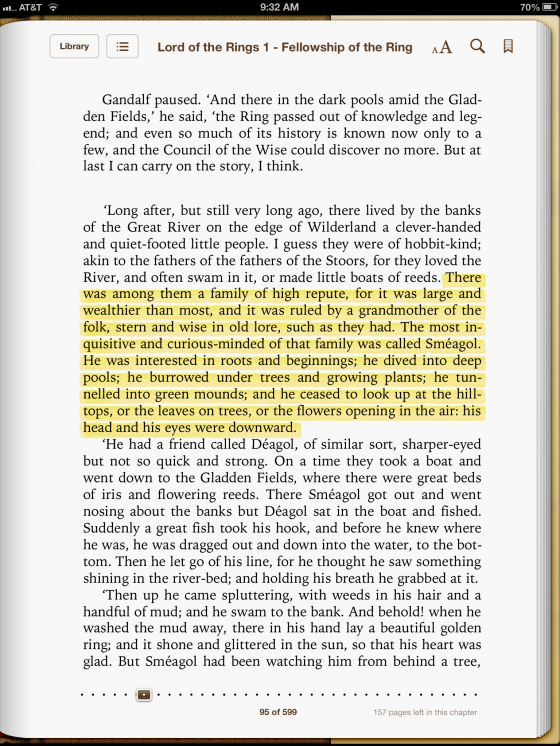
Gollum’s downward gaze shaped who he became. Instead of letting his curiosity help him explore the beauties of God, he let it drive him into the dark places. Smeagol became Gollum because he didn’t “look up.”
Curiosity is a gift from God…until you let it lead you to dark places. Instead of your curiosity looking for shadows of hope and grace scattered throughout the earth, it can lead you to search in dark corners of self-pity, self-hate and loneliness. Curiosity can lead you to your sin, your “dark places.”
When your gaze is always “downward,” you’re setting yourself up for a life where you’ll be dominated by your shame, guilt, and failures. Gollum is the prototypical person who is fully aware of their “thing,” their addiction, their “thorn in the flesh,” and who has made their life, and everyone else’s, revolve around that addiction. Gollum is so marked by his addiction that his whole existence revolves around it, and like a vortex he has sucked other people into his pain.
Time to look up.
26 Look up into the heavens.
Who created all the stars?
He brings them out like an army, one after another,
calling each by its name.
Because of his great power and incomparable strength,
not a single one is missing.
27 O Jacob, how can you say the Lord does not see your troubles?
O Israel, how can you say God ignores your rights?
28 Have you never heard?
Have you never understood?
The Lord is the everlasting God,
the Creator of all the earth.
He never grows weak or weary.
No one can measure the depths of his understanding.
29 He gives power to the weak
and strength to the powerless.
30 Even youths will become weak and tired,
and young men will fall in exhaustion.
31 But those who trust in the Lord will find new strength.
They will soar high on wings like eagles.
They will run and not grow weary.
They will walk and not faint.
How do you take positive steps away from your sin, and help ensure that your addiction and recovery don’t become your identity? How do you make sure you don’t consume others in your road to health? How do you ensure you’re not dominated by your guilt, shame, and fear?
6 Ways to Not Be Like Gollum
- Get outside. Enjoy the beauty of God’s creation. As you do, you’ll find the dark places of your heart a bit brighter. (Isaiah 40:26)
- Get outside. Remind yourself that there is a God…and that it’s not you. He’s all-powerful, you’re not. He knows all things…you don’t. He created the stars. You didn’t. (Isaiah 40:26-27)
- Exercise. There’s something healing about working strenuous, physical activity into your routine. Growing physically weak reminds us that God’s strength is perfect. (Isaiah 40:29)
- Serve someone else. Gollum served, and only thought about, himself. If you want to get out of your rut, do something for someone else, in a way that your favor can’t be “returned” back to you. Make life not about you.
- Remind yourself of the times that God has loved you and breathed hope into your story. (Isaiah 40:27)
- Trust in the Lord. (Isaiah 40:31) Easier said than done, though. Which is why you can’t do this on your own. Everything else can be done, just between you and God. But trusting in the Lord is too difficult to try to do by yourself. Bring someone else into your journey, and give them the freedom to speak hard, life-giving Truth into your story.


 , by JK Rowling

 , by JRR Tolkien


 , by John Ortberg